
Every day my inbox sees the same heartbreaking messages. People panicking that they are losing their hair, convinced they are just a few weeks away from balding, terrified because their shower drain looks like it survived a breakup. If you’ve ever stared at your hairbrush and felt that sinking feeling, you’re in good company. Hair fall can be dramatic, emotional, and deeply personal. But in most cases, what feels like catastrophic loss is simply normal hair shedding.
Before we go down the Google rabbit hole, let’s break down the truth about what’s normal, what’s not, and what 100 fallen strands actually look like. And yes, we’ll talk about what to do if you suspect you’re shedding more.
Hair Shedding v/s Hair Loss
This is the confusion that fuels half the panic on the internet. Hair shedding is your scalp being productive. A strand completes its four-stage cycle, falls out, and makes room for a fresh one. The American Academy of Dermatology describes this as a natural biological rhythm: hair shed so new hair can grow.
Hair loss, on the other hand, is when the shedding happens but the regrowth does not keep up. Instead of renewal, you start noticing thinning, widening parts, empty patches, or a ponytail that feels more like a shoelace.
| Normal Shedding | Abnormal Hair Loss |
|---|---|
| 50–150 strands/day | Sudden, heavy shedding |
| Even distribution across the scalp | Patchy or patterned thinning |
| No visible scalp | Scalp starts showing |
| New hair regrows | Little or no regrowth |
| Often temporary | Can be long-term or permanent |
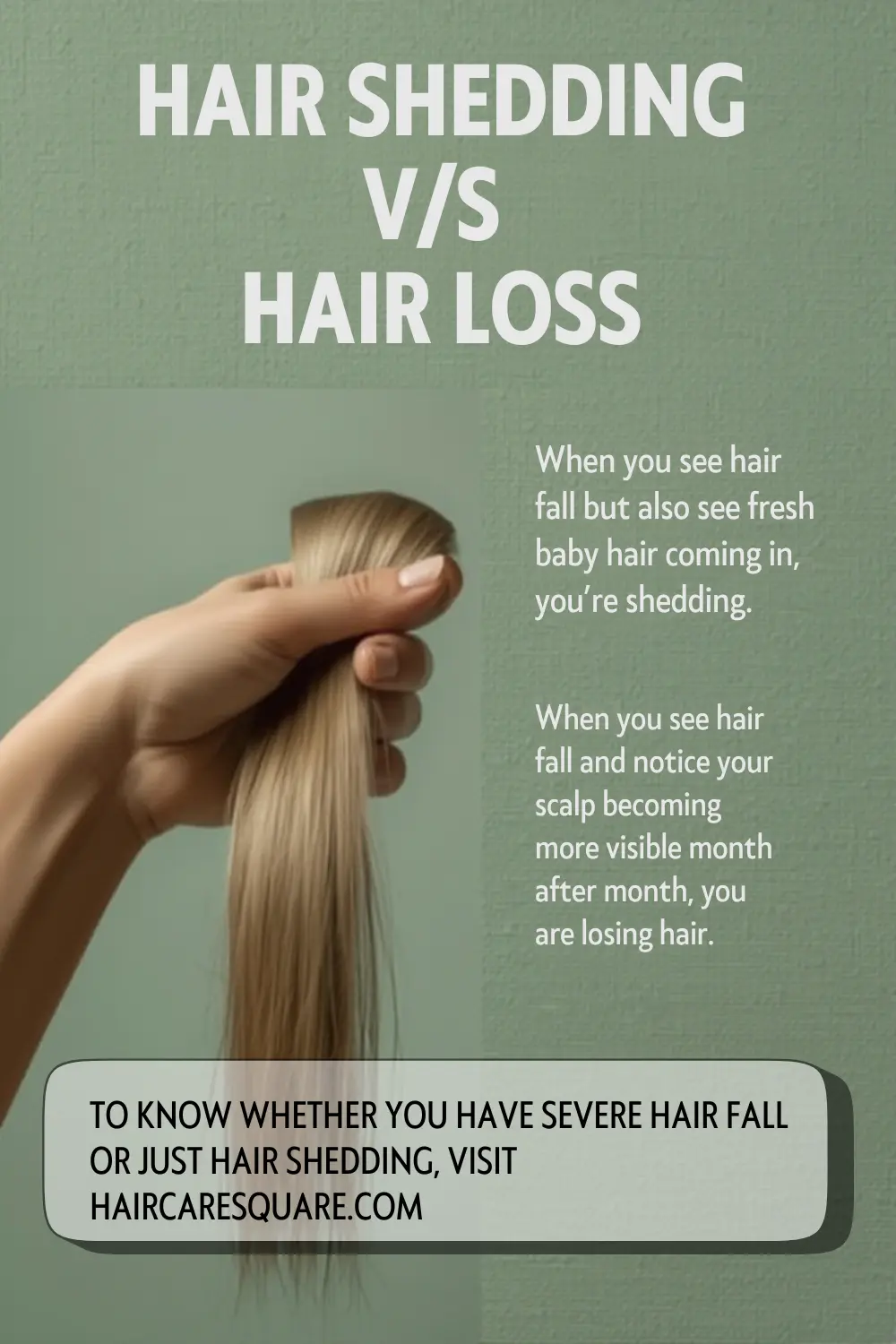
When you see hair fall but also see fresh baby hair coming in, you’re shedding. When you see hair fall and notice your scalp becoming more visible month after month, you are losing hair. And these two paths have very different solutions.
How Many Strands Of Hair Loss Per Day Is Too Many?
The Cleveland Clinic considers losing fifty to one-hundred fifty hair a day completely normal. And honestly, even I lose eighty to ninety strands a day, sometimes more. If you oil your hair, wash it, condition it, do a scalp massage, or simply comb more vigorously, you will see more strands in your hand.
That doesn’t automatically mean disaster.
Your hair is not trying to leave you. It’s just doing its job.
What Does 100 Strands Of Hair Look Like?
Most people dramatically overestimate what 100 strands look like. Collecting hair after a wash is often the easiest way to visualize it. When you let your hair air-dry and gently run your fingers through, you might notice a cluster of strands that looks alarming, but in reality, it represents several days of natural shedding that were waiting for wash day to make their grand exit. In your brush, around 100 strands appear as a small handful, not a frightening pile.
How To Exactly Know Whether You Have Severe Hair Fall Or Just Hair Shedding?
I know. It’s not always obvious. So here’s a simple test you can do at home.
Run your fingers through a small section of dry, clean hair. If ten to twelve strands cling to your fingers, that suggests you might be shedding more than usual. Repeat this once more from a different section. If the pattern stays consistent and you’re consistently pulling out large numbers, your scalp may be signaling something deeper.
If fewer than five or six strands come out each time, your hair is just cycling normally. If every ten strands out of a hundred are falling regularly, that’s excessive shedding. Listen to the signals.
Reasons For Severe Hair Loss
There are always root causes.
- Seasonal shifts that shock the scalp,
- a greasy,
- neglected scalp,
- hormonal imbalances,
- recovering from fever or illness,
- a reaction to a new hair product,
- frequent hair coloring or chemical smoothing,
- daily heat styling,
- diets low in essential nutrients,
- dehydration,
- stress that your scalp quietly absorbs until it can’t.
Hair doesn’t just fall; it reacts.
So, What To Do If You Are Shedding More Hair? How To Control It? Here Are Few HCS Tips That Will Help You
- Drink more water than you think you need. Dehydration quietly weakens the scalp.
- Include raw tomatoes and onions daily in your hair fall control diet your hair loves their natural compounds.
- Switch to a wooden comb and comb twice daily to reduce friction.
- Indulge in a weekly hot oil massage with an oil suited to your hair type.
- Steam your hair gently before washing to help the oils penetrate better.
- And always use shampoos that are free from SLS and other harsh surfactants that strip your scalp’s natural oils.
Product Recommendations
A gentle, nourishing hair fall control routine with right set of products make a world of difference.
Hair oiling, steaming & scalp massage
Oil your hair with hair oils that target hair fall and promote faster hair regrowth. You can make fenugreek hair oil, hibiscus hair oil at home or you can invest in a good cold-pressed hair oil that does the job.
Last update on 2026-03-06 / Affiliate links / Images from Amazon Product Advertising API
Last update on 2026-03-06 / Affiliate links / Images from Amazon Product Advertising API
Warm up your hair oil, apply evenly concentrating well on your hair and scalp, pamper it with some steam and do gentle scalp massage following the inversion method for hair growth.
Last update on 2026-03-06 / Affiliate links / Images from Amazon Product Advertising API
Opt For gentle shampoo for fair fall control
A shampoo that is free of harsh chemicals and was formulated with ingredients that target hair follicles with an intelligent formula that works quietly in the background while being gentle on your scalp.
Last update on 2026-03-06 / Affiliate links / Images from Amazon Product Advertising API
Use anti-fall hair serums
Invest in a lightweight, non-greasy serum that boosts density, nourish your hair and supports follicles.
Last update on 2026-03-06 / Affiliate links / Images from Amazon Product Advertising API
Last update on 2026-03-06 / Affiliate links / Images from Amazon Product Advertising API
Deep conditioning masks
Deep condition once a week with a hair mask that restores elasticity, reduces breakage, and makes shedding less dramatic.
Last update on 2026-03-06 / Affiliate links / Images from Amazon Product Advertising API
Last update on 2026-03-06 / Affiliate links / Images from Amazon Product Advertising API
When To Consult Your Doctor?
If you are losing between one hundred fifty and two hundred strands a day consistently, if new hair doesn’t seem to grow back, if your scalp is suddenly visible in ways it wasn’t before, if you see bald patches or widening gaps, it’s time to speak to a dermatologist.
The earlier you address the cause, the higher the chance of reversing the loss.
Over To You
Hair fall is universal. We all lose strands, and honestly, we’re supposed to. The trick is understanding your pattern, listening to your scalp, and responding with care rather than panic. Most shedding is harmless. Most fallen hair regrows. And when it doesn’t, the sooner you take action, the faster you’ll see the difference.
If you ever feel confused, message me. I’ll help you decode whether your scalp is shedding, stressing, or signaling change. Hair conversations are always welcome here.